
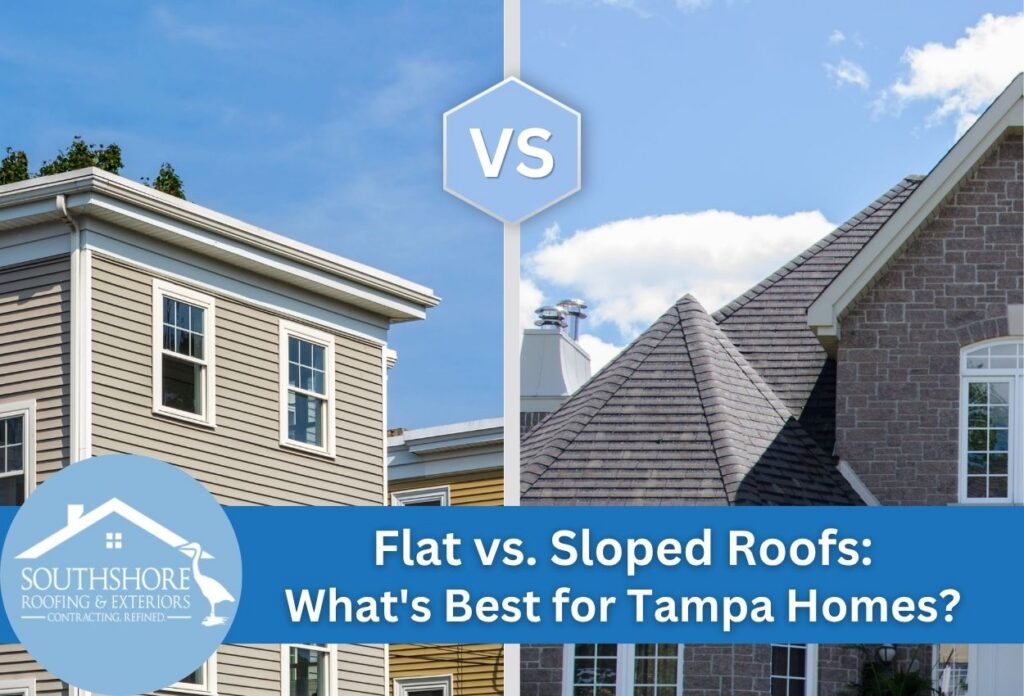

Both flat and sloped roofs can hold up in Tampa, but they perform very differently across the city’s 50 to 52 inches of annual rainfall, 70% to 75% year-round humidity, and Florida Building Code wind load requirements of 130 to 150 mph. Neither roof type wins on every measure. The right choice depends on how well each one handles Tampa’s specific conditions, not on general rules that apply anywhere in the country.
This article breaks the decision down across four factors that actually matter for Tampa property owners: drainage performance, durability in heat and humidity, hurricane resistance, and total cost of ownership over 15 to 25 years. These four factors separate a roof that lasts from one that drains your wallet every storm season.
Where you live in Tampa also matters. Coastal properties near Tampa Bay face higher wind exposure and salt-filled air than inland residential zones, and that changes which roof type makes the most sense.
How Do Flat and Sloped Roofs Handle Tampa’s Rain, Humidity, and Hurricane Season?
Sloped roofs outperform flat roofs in most of Tampa’s harshest climate conditions, but flat roofs can meet code when built with the right materials and drainage systems. Tampa averages 70 to 80 thunderstorms per year and 7 to 8 inches of rain per month from June through September, and each roof type responds to that in a completely different way.
| Performance Factor | Flat Roof | Sloped Roof |
|---|---|---|
| Drainage Performance | Requires internal drains, scuppers, or tapered insulation: ponding risk above 1/4 inch per 12 ft without proper slope | Natural runoff at a minimum 2:12 pitch: no ponding risk under normal rainfall |
| Hurricane Wind Resistance | Requires hurricane straps and impact-rated materials to meet 130 to 150 mph Florida Building Code wind pressure requirements | Properly pitched design provides inherently better wind uplift resistance: rated for 130 to 150 mph with standard reinforcement |
| Humidity and Mold Risk | Higher risk: standing water in 70% to 75% average humidity accelerates membrane breakdown and mold growth | Lower risk: water sheds quickly, reducing moisture retention in Tampa’s year-round humid climate |
| Debris Shedding | Debris accumulates on a flat surface: requires manual clearing after storms | Natural shedding on a pitched surface: debris clears with rain and wind |
| Salt-Filled Air Durability | Membrane surfaces exposed to coastal salt-filled air degrade faster, inspections are recommended every 1 to 2 years near Tampa Bay. | Less membrane exposure: shingles, metal, or tile hold up better against salt-laden coastal air |
The drainage gap is the biggest structural difference between these two roof types in Tampa. Flat roofs that lack properly engineered internal drainage systems can pond water fast during Tampa’s summer rain season, and standing water on a flat membrane in 80% to 85% summer humidity is a direct path to leaks and mold.
Florida Building Code requires all roofs in Tampa to withstand wind pressure of 130 to 150 mph, but flat roofs carry an extra compliance burden: they must incorporate hurricane straps and impact-rated materials per IBC standards adapted for Florida, while sloped roofs at proper pitch meet wind uplift requirements more naturally. For coastal properties near Tampa Bay, that added durability gap between the two roof types becomes even harder to ignore. If a storm causes damage, hurricane damage roof repair services can help restore your roof quickly and safely.
What Does a Flat Roof vs. a Sloped Roof Actually Cost to Install in Tampa?
Flat roofs cost less per square foot upfront, but sloped roof materials like concrete tile and metal panels last 20 to 40 years longer in Florida’s climate, and that gap changes the total cost picture fast.
| Roof Type / Material | Material Cost per Sq Ft | Installation Cost per Sq Ft | Average Total Cost (1,500 Sq Ft) | Expected Lifespan (Florida Climate) |
|---|---|---|---|---|
| TPO (Flat) | $1.50 to $3.50 | $2.00 to $4.00 | $5,250 to $11,250 | 15 to 25 years |
| EPDM (Flat) | $1.25 to $3.00 | $2.00 to $3.50 | $4,875 to $9,750 | 15 to 25 years |
| Modified Bitumen (Flat) | $1.50 to $3.00 | $2.00 to $4.00 | $5,250 to $10,500 | 15 to 20 years |
| Asphalt Shingles (Sloped) | $1.50 to $4.00 | $2.00 to $4.50 | $5,250 to $12,750 | 15 to 25 years |
| Metal Panels (Sloped) | $3.00 to $7.00 | $3.00 to $5.00 | $9,000 to $18,000 | 30 to 50 years |
| Concrete Tile (Sloped) | $3.50 to $7.00 | $4.00 to $6.00 | $11,250 to $19,500 | 30 to 50 years |
Hillsborough County requires engineered design permits for flat roofs to address wind uplift and ponding, adding $500 to $1,500 to project costs compared to standard sloped roof permit fees. Roofing installations in Tampa peak from October through May during the dry season. Scheduling during hurricane season (June through November) can extend project timelines and affect permit processing through Hillsborough County.
Metal panels and concrete tile carry higher upfront costs, but their 30 to 50 year lifespan in Florida’s climate means far fewer replacements and far less total spending compared to flat roof membranes that top out at 15 to 25 years. For property owners planning to stay long term, that lifespan difference is the most important number in this table.
Which Roof Type Lasts Longer in Florida Weather and What Does Maintenance Cost?
Metal roofing lasts the longest in Florida’s climate at 40 to 70 years, while most flat roof membranes and asphalt shingles top out at 15 to 20 years. Coastal salt-filled air and Tampa Bay humidity reduce those lifespans by 10% to 15% compared to inland Florida averages, so a TPO membrane rated for 15 to 20 years may need replacement closer to the 13 to 17 year mark on properties near the water.
| Material | Florida Lifespan | Coastal Reduction | Maintenance Requirement |
|---|---|---|---|
| TPO (Flat) | 15 to 20 years | 10% to 15% shorter near the coast | Biannual inspections: coating reapplication every 5 to 7 years |
| EPDM (Flat) | 20 to 25 years | 10% to 15% shorter near the coast | Biannual inspections are required to maintain the warranty |
| Modified Bitumen (Flat) | 15 to 20 years | 10% to 15% shorter near the coast | Biannual inspections: surface coating upkeep |
| Asphalt Shingles (Sloped) | 15 to 20 years | 10% to 15% shorter near the coast | Annual inspection recommended |
| Metal Panels (Sloped) | 40 to 70 years | Minimal with proper coating | Periodic fastener and sealant checks |
| Concrete Tile (Sloped) | 30 to 50 years | 10% to 15% shorter near the coast | Annual inspection: cracked tile replacement |
Flat roof membranes carry the heaviest maintenance burden in Tampa’s climate. UV exposure at Tampa’s latitude degrades membrane coatings 20% to 30% faster than in northern climates. That makes cool roof coating reapplication every 5 to 7 years a real budget line running $0.50 to $1.50 per square foot each cycle. Most TPO and EPDM manufacturer warranties also require biannual inspections, and skipping them voids coverage on many systems at the 5-year mark.
A single skipped inspection can cost far more than the $150 to $300 per-visit fee. Flat roof repairs average $400 to $1,200 per incident, making routine residential roof inspections one of the highest-return maintenance decisions a Tampa property owner can make. For property owners weighing long-term costs, SouthShore Roofing & Exteriors can assess your current roof’s condition and help you decide whether a maintenance plan or a full material upgrade makes more financial sense.
Flat vs. Sloped Roofs for Tampa Homes: Which Choice Fits Your Property Type and Budget?
The right roof type depends on your home’s design, location, and budget, and for most Tampa homeowners, 1 of the 2 choices below will fit clearly better than the other.
Choose a flat roof if…
- Your home is a modern or mid-century design: Flat roofs are standard on contemporary and minimalist homes common across Tampa, where low-profile rooflines match the architecture.
- Your property is commercial: Flat roofs are the industry standard for commercial buildings, and value-neutral in modern construction. No curb appeal penalty applies.
- You plan to install HVAC equipment or solar panels: Rooftop equipment is 15% to 20% easier to install and service on a flat surface than on a pitched one.
- Your budget for a 1,500 sq ft roof is under $10,000: EPDM and TPO flat roof installations typically fall within $4,875 to $11,250 for that square footage, below most sloped roof alternatives.
- Your HOA requires low-slope architecture: Some Tampa developments with contemporary design standards specifically restrict pitched rooflines.
Choose a sloped roof if…
- Your property sits within 1 mile of Tampa Bay: Wind uplift risk near the coast raises flat roof failure rates. Pitched roofs shed wind load more naturally and hold up better against salt exposure.
- Your home is in a traditional residential neighborhood: Sloped roofs are preferred by Tampa home buyers in these areas and can add 1% to 3% to appraised home value.
- You want a 30 to 50 year lifespan: Metal roofing panels and concrete tile far outlast flat roof membranes, which top out at 15 to 25 years even with proper maintenance.
- You want lower long-term maintenance costs: Flat roof membranes require coating reapplication every 5 to 7 years at $0.50 to $1.50 per square foot. Sloped roofs carry no comparable recurring cost.
- Your HOA requires traditional architecture: Many established Tampa neighborhoods have architectural guidelines that require pitched rooflines on residential properties.
Budget and location are the two fastest filters: if your roof is under $10,000 and your design calls for it, flat works. If you are within 1 mile of Tampa Bay or planning to stay long term, a sloped roof almost always delivers better value over time.
Does One Roof Type Save Tampa Homeowners More Money Over 20 Years?
Metal roofing costs more upfront, $18,000 to $25,000 installed on a 1,500 sq ft home, but delivers a lower 20-year total cost than TPO flat roofing when maintenance, recoating, and repairs are included. A TPO flat roof installed for $8,000 to $12,000 can add $4,000 to $8,000 in maintenance and recoating costs over the same period, closing the gap fast.
| Cost Category | TPO Flat Roof (1,500 Sq Ft) | Metal Sloped Roof (1,500 Sq Ft) |
|---|---|---|
| Installation Cost | $8,000 to $12,000 | $18,000 to $25,000 |
| Biannual Inspections (20 years) | $3,000 to $6,000 | $1,000 to $2,000 |
| Coating Reapplication (every 5 to 7 years) | $1,125 to $3,375 | None |
| One Mid-Cycle Repair Estimate | $400 to $1,200 | $200 to $600 |
| Estimated 20-Year Total Cost | $12,525 to $22,575 | $19,200 to $27,600 |
Florida homeowners’ insurance premiums can run 5% to 15% lower for hurricane-rated metal or tile sloped roofs compared to flat membrane roofs, which is $200 to $600 in annual savings depending on the insurer and proximity to the coast. Over 20 years, those savings alone can add up to $4,000 to $12,000, which flips the cost comparison further in metal’s favor. Reflective TPO membranes do offer one real offset: cool roof coatings can reduce cooling energy costs by 10% to 15% during Tampa’s 90 to 92°F summers, softening the long-term maintenance burden for flat roof owners.
When insurance savings and energy costs are both factored in, metal roofing’s 20-year total cost often runs equal to or below a TPO flat roof despite costing twice as much to install. For property owners doing the long-term math, SouthShore Roofing & Exteriors can provide a side-by-side cost breakdown based on your specific home and location.
Ready to Choose the Right Roof for Your Tampa Home? Here’s How to Get Started.
Knowing that metal roofing’s 20-year total cost can equal or beat a TPO flat roof despite costing twice as much upfront is exactly the kind of detail that changes a decision. But the right answer for your property also depends on your roof’s slope, drainage layout, and Hillsborough County permit requirements, all of which affect which material is actually approved and practical for your specific home.
Most reputable Tampa roofing contractors offer free estimates, and the October to May dry season is the best window to schedule an installation without weather delays. SouthShore Roofing & Exteriors works with Tampa homeowners to provide flat versus sloped roof cost comparison quotes based on real measurements, not ballpark guesses.
Request your free roofing estimate.
Not ready to schedule? Learn more about our Roof Replacement services.