

Roof Rejuvenation vs. Replacement in Tampa: Which Option Actually Solves Your Problem?

Tampa homeowners should choose roof rejuvenation when shingles show surface aging with less than 40% granule loss, but replacement is required when there is structural damage, deck rot, or a roof older than 20 to 25 years. The decision carries more weight here than in most parts of the country. Tampa’s combination of 70% to 90% humidity, 50 to 55 inches of annual rainfall, and intense year-round UV exposure ages roofs faster than nearly any other climate in the U.S.
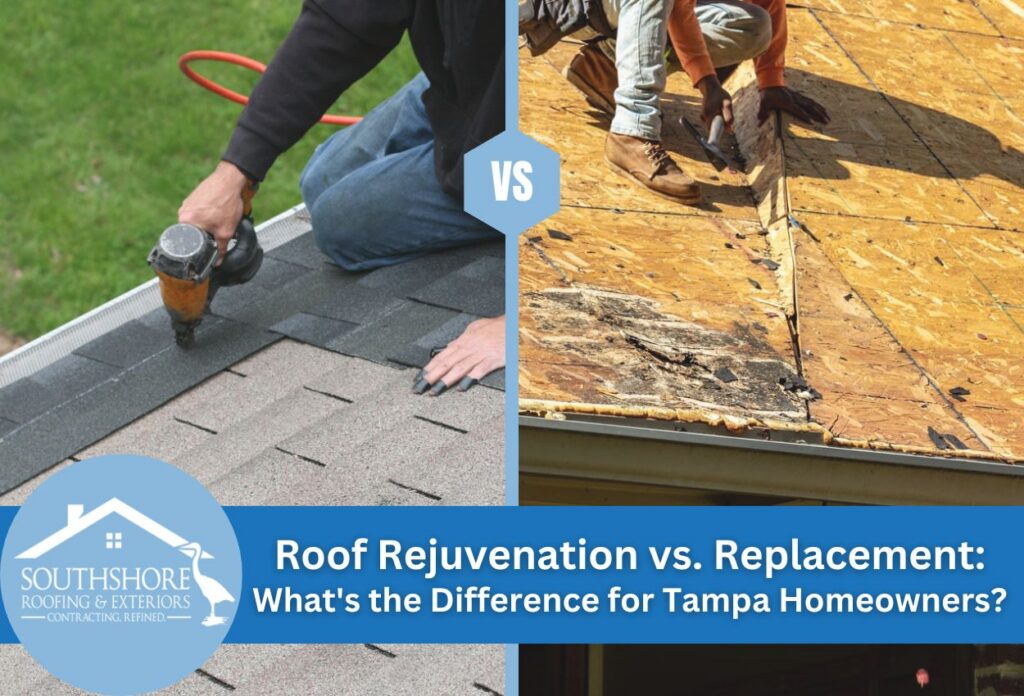
Roof rejuvenation is a spray-applied oil-based treatment that restores flexibility to dried-out asphalt shingles, extending their lifespan without a full tear-off. Roof replacement, by contrast, involves removing everything down to the deck and installing entirely new materials built to current wind and impact standards.
This article breaks down exactly which option fits your situation, covering costs, warning signs, local code requirements, and the best time of year to schedule work in Tampa.
*Please note, price ranges listed in this article may not reflect the final cost of your project. Prices are subject to change based on various factors such as local labor rates, material quality, and more. All costs established in this article are rough estimates based on average industry rates.
What Is the Difference Between Roof Restoration, and Replacement And What Does Each Actually Fix?
Roof rejuvenation restores lost oils in asphalt shingles to improve flexibility, while replacement removes all existing materials down to the deck and installs new wind-rated components, and the two options fix entirely different problems.
| Category | Roof Rejuvenation | Roof Replacement |
|---|---|---|
| Treatment Type | Spray-applied soybean or petroleum-based oil treatment | Full tear-off and reinstallation of all roofing layers |
| What It Fixes | Brittle, dried-out shingles with less than 40% granule loss | Deck rot, structural damage, failed flashing, end-of-life roofs |
| What It Cannot Fix | Deck damage, flashing failures, structural issues, or active leaks | N/A addresses all components from the deck to the surface |
| Typical Candidate Roof Age | 10 to 20 years old | 20 to 25+ years old |
| Application Time | 2 to 4 hours | 1 to 3 days |
| Permit Required in Hillsborough County | No structural permit required for maintenance treatments | State roofing license + Hillsborough County permit required. Miami-Dade approved, wind-rated materials mandatory |
Rejuvenation only addresses surface-level shingle aging; it cannot restore damaged roof decking, reseal flashing, or fix any structural component beneath the shingles. Replacement in Tampa carries an added requirement that all materials meet Miami-Dade-approved, wind-rated standards under the high-velocity hurricane zone designation, a specification that does not apply to rejuvenation treatments. If a roof is older than 20 to 25 years or has any structural compromise, rejuvenation will not solve the underlying problem.
How Do Roof Rejuvenation and Replacement Costs Compare for Tampa Homeowners?
Full roof replacement in Tampa typically costs 15x to 40x more than rejuvenation for the same roof footprint, a gap that makes rejuvenation worth serious consideration when shingles still have structural life left.
| Option | Average Cost (Tampa Market) | Cost per Square Foot | Typical Warranty |
|---|---|---|---|
| Roof Rejuvenation | $300 to $650 (2,000 sq ft roof) | $0.15 to $0.25 | 2 to 5 years |
| Asphalt Shingle Replacement | $9,000 to $15,000 | $4.50 to $7.50 | 25 to 30 years |
| Concrete Tile Replacement | $20,000 to $36,000 | $10 to $18 | 30 to 50 years |
The cost gap between rejuvenation and replacement is wide, but timing affects the total bill, too. Scheduling replacement or rejuvenation during Tampa’s wet season from June to September can add 10% to 15% in labor costs due to rain delays and extended project timelines. Booking work during the dry season from October through May is the most reliable way to keep costs down and avoid weather-related delays. For roofs with less than 40% granule loss and no deck damage, rejuvenation at $300 to $650 delivers meaningful lifespan extension at a fraction of replacement costs.
How Long Does Roof Rejuvenation Last Compared to Replacement?
Roof rejuvenation extends shingle life by 3 to 5 years per treatment and can be reapplied up to 2 to 3 times on qualifying roofs, adding a potential 6 to 15 years of total additional service life, but it is not a permanent fix and should never be treated as one.
New asphalt shingles last 20 to 30 years in moderate climates. In Tampa, that number drops to 15 to 22 years because of the intense UV index, 70% to 90% humidity, and coastal salt-filled air that accelerates shingle oxidation and granule loss. Those same conditions affect rejuvenation treatments, too. Tampa homeowners should factor in a 10% to 15% shorter effective window than the manufacturer’s stated product lifespan. Treatments rated for 5 years may realistically perform for 4 to 4.5 years here before another application is needed.
Rejuvenation works best on roofs that are 7 to 15 years old with intact roof decking and less than 40% granule loss. At that stage, shingles have dried out from heat and UV exposure but still have enough structural life left to benefit from restored flexibility. On a roof older than 20 to 25 years, treatments cannot overcome the cumulative damage already done; replacement becomes the only option that actually solves the problem.
The honest tradeoff is straightforward. Rejuvenation buys time at a low cost. Replacement resets the clock entirely for 15 to 22 years under Tampa conditions.
What Are the Signs Your Roof Needs Replacement, Not Rejuvenation?
If a roof shows any of the following conditions, rejuvenation will not resolve the problem; replacement is required, and delaying that decision risks interior water damage, failed inspections, and higher repair costs down the line.
- Granule loss exceeding 40% of the shingle surface: At this level, shingles have lost too much protective material for an oil treatment to restore meaningful function. Check gutters for heavy granule buildup as a fast indicator.
- Deck soft spots or sagging visible from the attic: Any flex, spongy feel, or visible dip in the roof decking means structural rot is present. Rejuvenation treats the surface only and cannot address what is underneath.
- Active leaks present for more than one season: A single unresolved leak over multiple rainstorms signals that the roofing system has already failed at a level beyond surface treatment, a situation that calls for emergency roof repair.
- Roof age over 20 years with no prior treatment: Shingles this old in Tampa’s climate have typically lost too much oil and granules to respond to rejuvenation effectively.
- More than 30% of shingles are cracked, curled, or missing: Widespread shingle failure across this much of the surface of the roof means the system is at the end of its life.
- Visible mold growth under shingles from trapped Gulf moisture: Tampa’s 70% to 90% humidity creates conditions where moisture becomes trapped beneath aging shingles, causing mold that compromises both shingles and roof decking.
- Hurricane or tropical storm uplift damage to flashing or ridge caps: Windstorm that compromise flashing or lift ridge caps leave the roof structurally vulnerable in ways that rejuvenation cannot fix. Homeowners in this situation should seek hurricane damage roof repair services immediately.
The pass/fail line is clear: roofs with less than 40% granule loss, no deck damage, no active leaks, and an age between 5 and 15 years are strong rejuvenation candidates. Roofs outside any of these parameters should be inspected by a licensed contractor. Most will qualify for replacement, not treatment. When in doubt, a professional inspection takes the guesswork out of the decision entirely.
Is Roof Rejuvenation Worth It, or Should You Replace? The ROI Breakdown for Tampa Homes
A $500 rejuvenation treatment that delays a $12,000 replacement by 5 years saves roughly $2,300 per year in avoided capital expenditure, making rejuvenation a strong financial decision when shingles still qualify. That math only works, though, if the roof passes the structural tests covered in the previous section. For roofs that do qualify, the numbers are hard to argue with.
| Scenario | Upfront Cost | Total 10-Year Cost | Years Before Next Major Expense |
|---|---|---|---|
| Scenario A: Rejuvenation now + replacement in Year 5 | $500 (treatment) + $12,000 (replacement in Year 5) | $12,500 | 5 years before replacement; 10+ years after that |
| Scenario B: Immediate replacement | $12,000 | $12,000 | 15 to 22 years before the next replacement under Tampa conditions |
Scenario B costs less over 10 years, but Scenario A preserves $11,500 in cash today, a meaningful difference for most homeowners. Homeowners who need help managing the upfront cost of a full replacement can also explore roof financing options to spread the expense over time. There is also a secondary benefit worth noting. Reflective restoration coatings can reduce attic temperatures by 10 degrees to 20 degrees Fahrenheit, which matters in a climate where AC runs 8 to 10 months per year. That cooling benefit does not make rejuvenation the right call on a failing roof, but on a qualifying roof, it adds real value on top of the cost deferral. Get a professional inspection first, the decision follows from the condition of the roof, not the cost alone.
Ready to Decide? Here’s How to Get the Right Answer for Your Tampa Roof
Choosing between a $300 to $650 rejuvenation treatment and a $9,000 to $15,000 replacement comes down to one thing: what condition your roof is actually in, and only a professional inspection can tell you that with confidence.
A qualified Tampa roofing contractor can measure granule loss percentage, check roof decking condition, and assess shingle age to tell you which option makes sense. Schedule that inspection between October and February to allow dry-season project completion before the June hurricane season begins. SouthShore Roofing & Exteriors serves Tampa and surrounding Hillsborough County homeowners and is fully licensed under Florida state requirements and familiar with local wind-rated code standards.
Schedule your free roof inspection
Not ready to schedule? Learn more about roof rejuvenation in Tampa.