

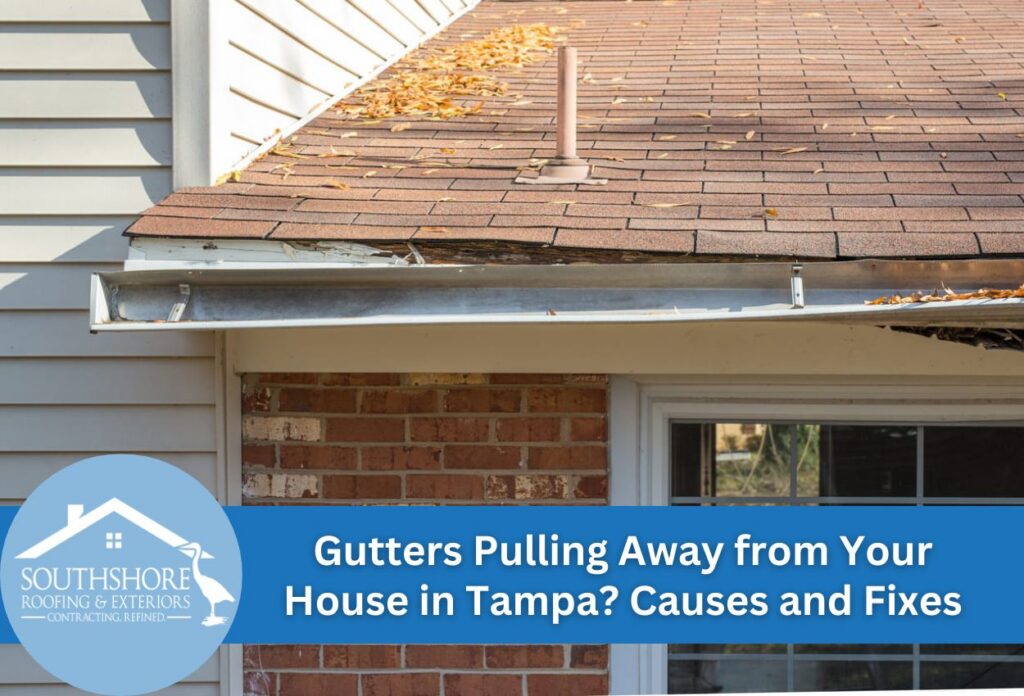

Gutters pulling away from the house are one of the most common gutter failures in Tampa, driven by the city’s 50 to 55 inches of annual rainfall packed into roughly 4 to 5 peak summer months, a pattern that puts repeated weight stress on every fastener point along the roofline. Each heavy downpour adds load to gutters that may already be clogged, sagging, or poorly attached, and after enough storms, that stress adds up fast.
The cost to fix this problem depends entirely on what caused it. A loose fastener can cost under $50 to repair yourself. A rotted fascia board behind the gutter runs $300 to $900 or more when a contractor replaces it properly. Knowing which situation you have makes a real difference before spending money on the wrong repair. Most Tampa homeowners first notice the separation during rainy season, June through September, when gutters overflow, sag, or visibly gap away from the fascia board.
*Please note, price ranges listed in this article may not reflect the final cost of your project. Prices are subject to change based on various factors such as local labor rates, material quality, and more. All costs established in this article are rough estimates based on average industry rates.
What Causes Gutters to Pull Away from the Fascia Board in Tampa Homes?
Five specific conditions cause most gutter separations in Tampa, and the right fix depends on identifying which one you have before touching anything.
- Rotted fascia boards: Untreated wood fascia boards can begin to rot in as little as 3 to 5 years in Tampa’s humid climate. Once the wood softens, screws and hangers lose their grip, and the entire gutter section pulls free. This is not a DIY fix. A rotted fascia board requires professional replacement before any gutter reattachment can hold.
- Failed gutter spikes: Spike-and-ferrule fasteners were standard hardware through the 1990s and have a functional lifespan of 10 to 15 years before backing out. Spike failure alone without underlying rot is often DIY-addressable by replacing old spikes with hex-head screws and gutter hangers.
- Overflow weight from clogged gutters: A 10-foot section of aluminum gutter filled with standing water and debris can weigh 80 to 100 lbs, enough to stress every fastener along the run during a heavy Tampa downpour. Tampa’s summer downpours hit fast and hard, and that repeated stress pulls hangers loose at every stressed attachment point along the roofline.
- Improper original pitch causing pooling: Gutters need a consistent slope toward the downspout, generally about ¼ inch of drop per 10 feet of run. Flat or back-pitched sections hold standing water and add constant weight between storms. Minor pitch corrections are sometimes manageable as a DIY task; structural soffit damage beneath requires a professional.
- Coastal salt-filled air corrosion: Within 5 to 8 miles of Tampa Bay, salty air accelerates corrosion on fasteners and gutter hardware, weakening the connection points faster than inland properties experience. Metal hangers and screws in these areas may fail years ahead of their expected lifespan.
The clearest gutter pulling away from the roof water damage signs include fascia board staining, paint bubbling, soft wood when pressed near the roofline, or a visible gap greater than ¼ inch between the back of the gutter and the fascia board. If the fascia board feels soft when you press it firmly, stop: professional repair is the right call before any reattachment attempt.
Can You Reattach Gutters to the House Yourself, or Do You Need a Pro in Tampa, FL?
Most homeowners can handle reattaching gutters to the house in Tampa, FL, on their own, but only if the fascia board behind the gutter is solid, dry, and undamaged. Run through these five diagnostic questions first.
- Is the fascia board soft or crumbling when pressed firmly? Yes = call a pro. Soft fascia board means rot has set in, and no fastener will hold in compromised wood. Reattaching gutters here without replacing the board first is a temporary fix at best.
- Are the existing gutter spikes simply backed out with no fascia board damage? Yes = DIY is viable. Replace old 7-inch gutter spikes with 1/4-inch x 1.5-inch hex-head gutter screws, which cost $8 to $15 per box of 50 and take 1 to 2 hours for a standard 40-foot gutter run.
- Is the gap between the gutter and fascia board greater than 1 inch? Yes = likely a structural issue. Gaps this wide usually mean the wood behind has swelled, shifted, or deteriorated beyond a simple screw fix.
- Does the fascia board show visible staining, paint bubbling, or dark discoloration? Yes = moisture damage is present. Even if the wood feels firm, internal rot may have started. A professional inspection is recommended before any reattachment work begins.
- Does the repair involve the soffit or require removing more than a single gutter section? Yes = check permit requirements first. In Hillsborough County, fascia board replacement or soffit work may fall under Florida Building Code review, and homeowners should confirm permit thresholds with the county before any structural repairs start.
If every answer above is “no” except the second one, a DIY screw replacement is a reasonable weekend fix. Any softwood, visible rot, or soffit involvement shifts the job to a licensed contractor: attempting to skip that step risks a repeated failure within the next storm season. SouthShore Roofing & Exteriors can assess the fascia board condition and complete gutter repairs and installations that hold up to Tampa’s heavy summer rain.
What Are the Signs of Water Damage Behind Pulling Gutters, and How Bad Can It Get?
Gutters pulling away from the house for just one to two rainy seasons can deteriorate a wood fascia board from surface staining to full rot in as little as 18 to 36 months under Tampa’s humidity and rainfall conditions. That timeline moves fast, and the damage rarely stays contained to the gutter line alone.
The gutter pulling away from the roof, water damage signs that show up earliest, are also the easiest to spot from the ground. Look for soffit staining visible at ground level, fascia board paint peeling in strips wider than 2 inches, and mold growth on siding within 6 to 12 inches below the gutter line. At the foundation, soil washout or splash erosion within 12 inches of the drip line means water has been hitting the ground hard and redirecting toward the structure instead of away from it.
Each of those signs points to a specific stage in a worse problem. Surface staining means moisture is present. Paint peeling in wide strips means the wood beneath is absorbing water repeatedly. Mold on siding means the saturation is consistent enough to support growth between storms, and when that moisture reaches the roofline, it may also cause rain leak damage requiring emergency roof repair.
Untreated fascia board rot that spreads into roof decking or rafters can push repair costs from a $300 to $600 fascia board replacement all the way to $2,500 to $6,000 or more for partial roof deck and framing repairs. That cost gap alone makes catching the damage early the highest-return action a Tampa homeowner can take. SouthShore Roofing & Exteriors can assess how far the damage has progressed before the repair scale and the bill gets larger.
How Much Does It Cost to Fix Gutters Pulling Away from the House in Tampa?
Gutters pulling away from the fascia board repair in Tampa ranges from a $15 DIY materials job all the way to $2,500 or more when rot and structural damage are involved, and Tampa labor rates for gutter and fascia board work typically run $45 to $85 per hour, depending on crew size and company.
| Repair Type | DIY or Pro | Typical Tampa Cost Range | Time to Complete | When It’s Needed |
|---|---|---|---|---|
| Gutter spike replacement with screws | DIY | $15 to $40 materials | 1 to 2 hours | Spikes backed out, fascia board intact |
| Re-hanging detached gutter section | Pro | $75 to $200 per section | 1 to 3 hours | Gutter sagging, fascia board still solid |
| Fascia board replacement (per linear foot) | Pro | $8 to $20 per LF installed | 1 to 2 days for a full run | Rotted or soft fascia board confirmed |
| Full gutter system re-hang with new hardware | Pro | $300 to $700 for an average home | Half to full day | Widespread fastener failure |
| Fascia board and gutter replacement combined | Pro | $900 to $2,500+ | 1 to 3 days | Severe rot, structural damage |
The jump from a simple re-hang to a combined fascia board and gutter replacement is steep. Catching the problem at the spike failure stage before rot sets in keeps costs under $200 in most cases. Once the soft fascia board is confirmed, the same repair can cost 10 times more. Scheduling gutter pulling away from fascia board repair in Tampa during the dry season, November through February, may result in faster contractor availability and potentially 5 to 10% lower costs than peak summer demand windows.
What Is the Smartest Long-Term Fix to Prevent Gutters from Separating Again During Florida’s Rainy Season?
Replacing old gutter spikes with hex-head screws is the single most cost-effective upgrade a Tampa homeowner can make, and when combined with a full seamless system, it eliminates most repeat failures for 20 to 30 years. The loose gutter spikes replacement screws fix works because hex-head gutter screws thread directly into the fascia board wood rather than relying on friction, giving them 3 to 4 times more pull-out resistance than the original smooth-shank spikes. That difference matters every time a Tampa summer storm drops an inch of rain in 30 minutes, and when storms cause broader roofline damage, roof storm damage repair may also be needed alongside gutter work.
| Upgrade Path | Upfront Cost | Expected Lifespan | Best Suited For |
|---|---|---|---|
| Re-spike with original nails | $10 to $20 | 3 to 7 years before re-failure | Temporary patch only: not recommended as a long-term fix |
| Re-hang with hex-head gutter screws into solid fascia board | $15 to $40 DIY or $75 to $200 pro | 15 to 25 years if the fascia board is sound | Homes with intact fascia board and backed-out spike failure |
| Full upgrade seamless aluminum gutters, fascia board replacement, and gutter guards | $1,200 to $3,500 for an average Tampa home | 20 to 30 years with minimal maintenance | Homes with rot damage, chronic overflow, or near-coastal salty air exposure |
The ROI math is straightforward. Homeowners who invest in a one-time seamless gutter and fascia board upgrade avoid an average of 1 to 2 repeat repair calls per decade at $150 to $400 each, and they reduce their exposure to $2,500 to $6,000 or more in structural damage that spreads when failing gutters go unaddressed. Re-spiking with original nails costs the least today, but almost always leads to another failure. Switching to screw-based hardware or upgrading the full system is the repair that actually holds through Tampa’s rainy season year after year.
Ready to Stop Your Gutters from Pulling Away? Here’s How Tampa Homeowners Can Get Started
Booking a gutter and fascia board inspection between February and April means shorter lead times and repairs finished before Tampa’s rainy season begins in June, avoiding the $2,500 to $6,000 or more in structural damage that a missed failure can cause.
One visit is all it takes to find out whether the fix is a $30 screw replacement or a full fascia board repair job. SouthShore Roofing & Exteriors offers no-cost on-site assessments for Tampa homeowners and removes the guesswork entirely.
Schedule your free gutter inspection.
Not ready to schedule? Learn more about gutter and fascia board repair options.