

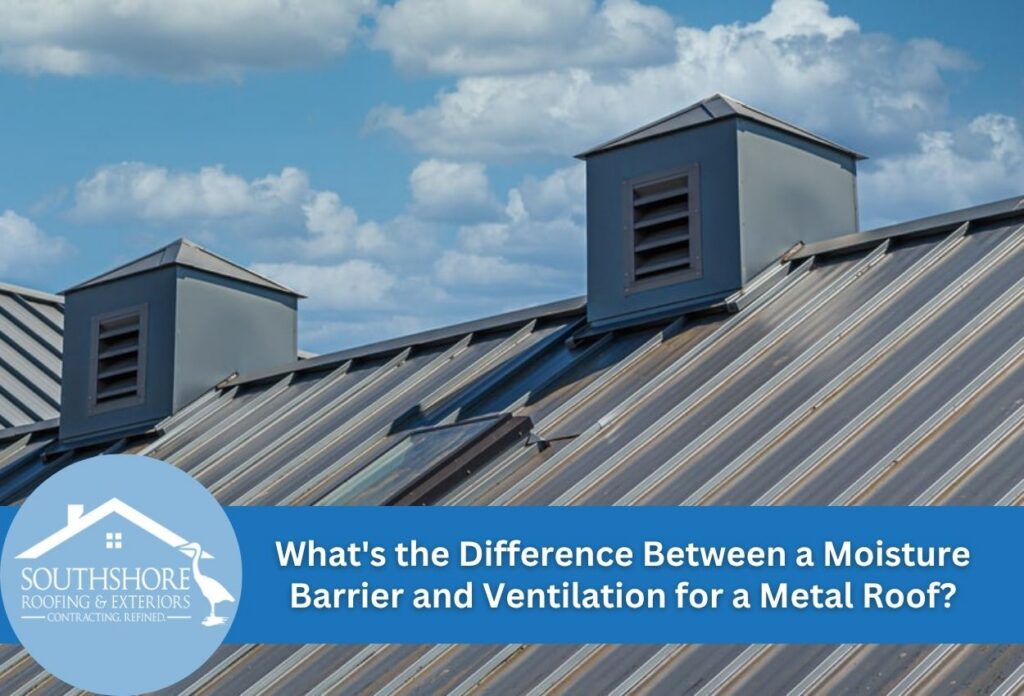
What’s the Difference Between a Moisture Barrier and Ventilation for a Metal Roof?

Tampa’s average relative humidity of 74% to 76% and summer dew points that regularly exceed 75 degrees mean metal roof condensation is one of the most common local roofing failures, and a surface temperature difference of as little as 2 to 3 degrees below the dew point is enough to trigger sweating under metal panels. That threshold gets crossed frequently in Tampa attics, especially during the long wet season stretching from May through October.
A moisture barrier is a physical layer, usually a membrane or underlayment that blocks or slows water vapor from moving into the roof assembly. Ventilation is an airflow system that removes humid air before it can condense on cooler metal surfaces. In a humid climate like Tampa’s, most metal roof assemblies need both working together, not one or the other, with the right combination depending on attic type and roof design.
Why Do Metal Roofs Sweat and What Causes Condensation Under Metal Roof Panels in Florida?
Metal roof panels can drop 10 to 20 degrees below ambient air temperature on clear nights through a process called radiative cooling, and when Tampa’s outdoor dew points average 72 to 76 degrees from June through September, that temperature drop alone is enough to trigger condensation on the underside of panels without a single drop of rain falling.
Three specific conditions in Tampa drive this problem. First, warm humid outdoor air infiltrates attic spaces throughout the 5 to 6 month wet season, loading the attic with moisture-heavy air that has nowhere to go. Second, warm and humid outdoor air can easily bypass poor air sealing and enter the attic space, pushing moisture-laden air against roof surfaces that rapidly cool after sunset. Third, metal panel fasteners and purlins create thermal bridging. Steel conducts heat about 400 times faster than wood, so localized sweating concentrates at every fastener point even when the rest of the panel stays dry.
All three drivers can be active at the same time in a Tampa home, which is why addressing only one of them rarely solves the condensation problem. Florida Building Code addresses this reality by demanding moisture control strategies where vapor drive from the hot, humid exterior toward cooled interiors is a concern, and that enclosed attic and rafter spaces include cross-ventilation. Those two code requirements one targeting vapor control, one targeting airflow correspond directly to the two-layer solution that Tampa metal roof assemblies need.
Moisture Barrier vs. Ventilation for Metal Roofs: How Do the Two Approaches Compare on Performance?
Neither a moisture barrier alone nor ventilation alone meets Florida’s performance standard for metal roof assemblies. The two approaches target different moisture pathways, and Tampa’s climate makes both necessary in the same assembly.
| Category | Moisture Barrier | Ventilation |
|---|---|---|
| Primary Function | Blocks vapor drive through the roof assembly | Removes humid air before it condenses on metal surfaces |
| Effective Humidity Range | Class I vapor retarders rated at 0.1 perm or lower are strictly required to handle high vapor drive conditions | Best performance above 1:150 net free area ratio per Florida Building Code |
| Installation Location | Directly under metal panels, on top of roof deck | Ridge-to-soffit airflow path; intake at soffits, exhaust at ridge |
| Florida Code Applicability | Required where vapor flow from warm, humid interiors is a concern | Required for enclosed attic and rafter spaces; minimum 1:150 net free area ratio |
| Limitation in High-Humidity Climates | Does not remove existing humid air already trapped in attic space | Insufficient alone when outdoor dew points exceed 70 degrees for 90+ days per year |
Tampa averages about 120+ days per year with outdoor dew points above 70 degrees, well past the threshold where ventilation without a vapor control layer fails to protect metal roof assemblies over conditioned space.
A Class I vapor retarder rated at 0.1 perm or lower is the standard recommendation for Florida metal roof assemblies over conditioned space, while ventilation handles the humid outdoor air infiltrating from the soffit side. The direct answer to whether metal roofs need ventilation or a moisture barrier: Florida’s climate data and code both point to a combined assembly where the moisture barrier handles vapor drive pushing up from inside, and ventilation handles humid air entering from outside. SouthShore Roofing & Exteriors installs both layers as a standard practice on Tampa metal roof projects.
What Is the Best Underlayment for Metal Roof Moisture Control in Tampa’s Climate?
Self-adhered vapor retarder membrane outperforms all other underlayment types for metal roofing systems in Tampa, with a perm rating of 0.1 or lower and full roof deck adhesion that eliminates the open laps where wind-driven rain infiltrates during high-winds.
| Underlayment Type | Perm Rating | R-Value | Wind Uplift Rating | Cost per Square (100 sq ft) | Florida Product Approval Required | Condensation Control Rating |
|---|---|---|---|---|---|---|
| #30 Roofing Felt | 5.0 to 6.0 | None | Up to 60 mph | $8 to $15 | Yes | Low |
| Synthetic Non-Perforated | 1.0 to 3.0 | None | 90 to 120 mph | $15 to $30 | Yes | Medium |
| Self-Adhered Vapor Retarder Membrane | 0.1 or lower | None | 130+ mph | $40 to $65 | Yes | High |
| Insulated Reflective (Foil-Faced Foam) | 0.5 to 1.5 | R-2 to R-6 | 90 to 110 mph | $35 to $60 | Yes | High |
Open-seam felt underlayments have failed in Florida wind storms at sustained speeds above 60 mph a threshold Tampa regularly approaches during tropical storms and hurricanes. Insulated reflective underlayment adds meaningful value during Tampa’s shoulder seasons (March through May and October through November), raising panel surface temperature by 2 to 4 degrees and reducing how often surface temperatures drop close to the dew point when temperature swings are most pronounced.
Self-adhered vapor retarder membrane at 0.1 perm or lower is the strongest match for Tampa’s humid climate, because full roof deck adhesion blocks wind-driven leaks at laps while meeting Florida’s wind-driven rain testing requirements for coastal zones, something lapped or mechanically fastened underlayments cannot reliably deliver in this region.
How Do You Stop Condensation Under Metal Roof Panels and In What Order Should You Address It?
Follow this 7-step sequence to diagnose and fix metal roof condensation correctly skipping steps or working out of order is the most common reason Tampa homeowners get repeat moisture problems after an initial repair.
- Measure attic relative humidity with a digital hygrometer. If readings consistently exceed 60% RH during summer months, ventilation alone will not resolve the problem in Tampa’s climate. Record readings at the same time each morning for at least 5 consecutive days.
- Inspect all ceiling gaps for air leaks. Light fixtures, plumbing chases, and HVAC boots are the most common paths for conditioned air to push moisture up into the attic. Seal any gap wider than 1/16 inch with appropriate fire-rated caulk or foam before addressing ventilation.
- Verify attic ventilation ratio using the 1:150 rule. Calculate net free area: 1 sq ft of vent per 150 sq ft of attic floor area, which can be reduced to 1:300 if 40% to 50% of the required ventilating area is provided by ridge vents. Undersized ventilation is one of the most common deficiencies found in Tampa’s mid-century housing from 1950 to 1979 builds.
- Check the underlayment perm rating against Tampa’s moisture. Any underlayment with a perm rating greater than 1.0 is considered semi-permeable and allows some water vapor diffusion through the roof assembly. A self-adhered vapor retarder membrane rated at 0.1 perm or lower is the standard recommendation for Florida metal roof assemblies over conditioned space.
- Inspect insulation for wetting from above. Press a moisture meter probe into the top surface of batts or blown insulation a reading above 15% moisture content indicates active condensation dripping down from the metal panels, not exterior leaks at the eave line.
- Check the soffit and eave area for moisture patterns. Wet staining or mold growth concentrated at the soffit line and eave area rather than mid-roof deck points to exterior humid air infiltrating through soffit vents. This distinguishes interior vapor leaks from exterior vapor drive, which pushes moisture inward from outside and leaves the eave area vulnerable.
- Confirm all ridge and soffit vents are unobstructed and balanced. Blocked soffit vents reduce intake airflow, which stalls the ridge-to-soffit convection path. A balanced system requires both intake and exhaust to function ridge vents alone without clear soffit intake will pull humid outdoor air through any gap rather than cycling it out.
Distinguishing interior vapor drive from exterior humid air is the single most important diagnostic step. The repair path is different for each source, and treating the wrong one wastes both time and money. SouthShore Roofing & Exteriors follows this sequence on every Tampa metal roof moisture assessment to match the repair to the actual cause. If storm damage has accelerated leaks, our emergency roof storm damage service can address urgent repairs before a full moisture assessment is completed.
What Does It Cost to Fix Metal Roof Condensation Moisture Barrier, Ventilation, or Both?
Fixing metal roof condensation ranges from roughly $800 to $18,000 depending on whether the problem requires a ventilation upgrade only, underlayment replacement only, or a full
combined system and choosing the wrong fix wastes money without solving the root cause.
| Remediation Scenario | Estimated Labor Cost | Estimated Material Cost | Total Cost Range per 1,000 sq ft | Expected Lifespan of Solution | Condensation Risk Reduction (%) |
|---|---|---|---|---|---|
| Ventilation Upgrade Only (ridge vent + soffit vents) | $500 to $1,200 | $300 to $1,000 | $800 to $2,200 (for 1,500 sq ft) | 20 to 30 years | 30% to 50% |
| Moisture Barrier / Underlayment Replacement Only | $0.75 to $1.25 per sq ft | $0.75 to $1.50 per sq ft | $1.50 to $2.75 per sq ft installed | 25 to 40 years | 40% to 60% |
| Full Combined System (new underlayment + ventilation upgrade) | Included in total | Included in total | $9,000 to $18,000 (for 1,500 sq ft) | 40+ years | 80% to 95% |
Ventilation alone reduces condensation risk but leaves vapor drive through the roof deck unaddressed a partial fix that still allows deck rot and insulation damage over time. Skipping early repairs gets expensive fast: blown-in attic insulation replacement runs $1,200 to $3,500, wooden roof deck rot repair costs $2,000 to $6,000, and unmanaged moisture can shorten a 40-year panel warranty to just 15 to 20 years of functional life in coastal humid environments.
A full combined system costs more upfront but is the only approach that protects against both interior water vapor and exterior humid air the two separate moisture pathways that Tampa’s climate puts on every metal roof simultaneously. Homeowners dealing with moisture damage from recent storms may also be eligible for coverage through our emergency roofing insurance claims assistance service.
Ready to Solve Your Metal Roof Moisture Problem? Here’s How SouthShore Roofing & Exteriors Can Help Tampa Homeowners.
Getting a full combined system installed before June keeps your roof out of the highest condensation risk window and avoids the contractor scheduling delays that stack up fast once Tampa’s wet season hits. SouthShore Roofing & Exteriors serves Tampa homeowners with metal roof moisture assessments, underlayment replacement, and ventilation installation sized to Florida’s coastal humidity demands. Our residential roof inspection service is the right starting point for homeowners who want a professional assessment of their current moisture barrier and ventilation setup before committing to a repair.
Schedule your free roof assessment
Not ready to schedule? Learn more about metal roof moisture control and underlayment installation.